Probing Non-Equilibrium Grain Boundary Dynamics with XPCS and Domain-Adaptive Machine Learning
† Equal contribution. * Corresponding author.
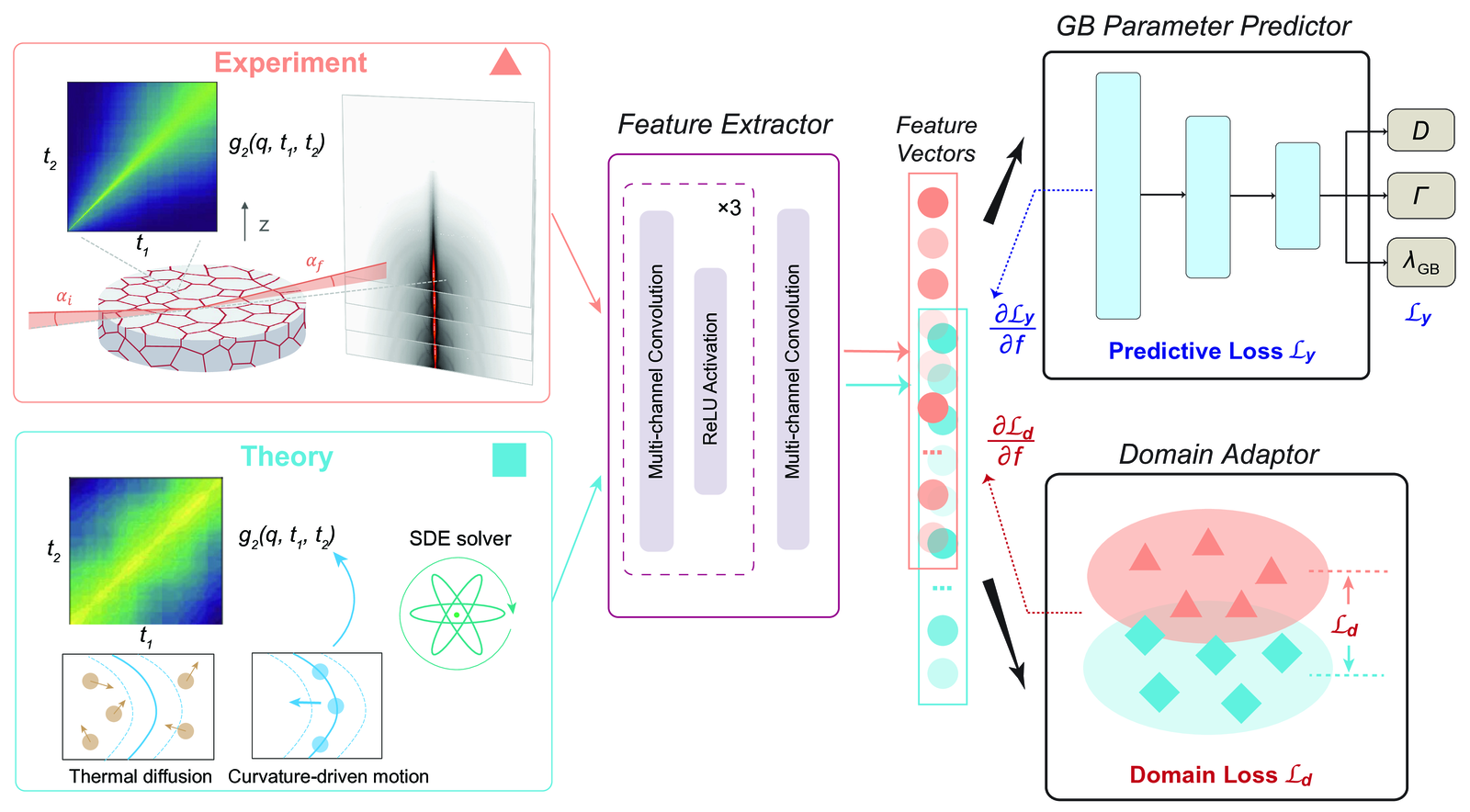
Grain-boundary motion shapes the stability, mechanics, and functional response of nanocrystalline materials, but its slow non-equilibrium dynamics are difficult to measure directly. In this work, we establish X-ray photon correlation spectroscopy (XPCS) as a route to probe these dynamics through two-time correlation maps measured from nanocrystalline silicon. We combine temperature- and grain-size-dependent XPCS experiments with continuum simulations of diffusion and curvature-driven grain-boundary migration. The resulting maps reveal departures from time-translation invariance, showing that grain-boundary relaxation can remain far from equilibrium over experimental timescales. To extract quantitative kinetic parameters from noisy experimental fluctuation maps, we introduce a semi-supervised domain-adaptive learning framework. By aligning simulated and experimental XPCS representations, we infer physical parameters including bulk diffusivity, grain-boundary stiffness, and effective grain-boundary concentration from unlabeled experimental measurements.