Can God Be Proved to Exist? —Regarding Anselm’s Ontological Argument
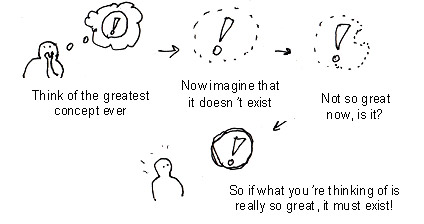
Note: This blog post was one of my course papers for Problems of Philosophy class (24.00) at MIT, written in Spring 2025. It was also my first attempt at writing a philosophical paper.
1. Introduction
Anselm’s ontological argument, presented in Proslogion II, seeks to demonstrate the existence of God solely by reflecting on the concept of God as “something than which nothing greater can be thought.” (Anselm, 1077-78/2018, p.8) In this paper, I will reconstruct Anselm’s argument, critically examine its premises—particularly the notions of “greatness” and “existence in mind”—and evaluate Gaunilo’s analogous “perfect island” objection. Finally, I will discuss whether a rational theist truly requires a formal proof of God’s existence.
2. Argument Reconstruction
Following Proslogion II, Anselm’s argument can be summarized as follows:
- (Definition) God is defined as the absolute perfect, greatest conceivable being.
- (Premise 1) Every human mind can conceive of God—even for those who claim to deny His existence, for instance, the biblical fool (Psalm 14:1) who declares “There is no God.”
- (Premise 2) Whatever been conceived exists in mind, at least as a mental construct.
- (Conclusion from 1, 2) Therefore, God must exist in mind. Even the atheist, by engaging with the idea of God, grants Him mental existence.
- (Conclusion from 3) Either God exists only in mind, or God exists both in mind and in reality.
- (Premise 3) A being that exists in reality is greater than one that exists only in the mind. This comparative principle stems from human’s everyday experience: a real being always surpasses an imagined one in perfection because it participates in actuality.
- (Conclusion from 5) If God exists only in mind, He would not be the greatest conceivable being, since a being identical in all respects but existing in reality would be greater. This directly contradicts the definition of God (0), which requires Him to exemplify maximal greatness.
- (Final Conclusion from 0, 4, 6) Thus, to be the absolute greatest, God must exist in reality as well as in the mind.
3. Critical Analysis of Key Premises
3.1. Possible Objection: The Ambiguity of “Greatness”
Anselm’s reasoning relies heavily on a comparative concept of “greatness”, as illustrated in Premise 3. He argues that a non-existent being is not so great as a real being that possesses all the same properties and exists in reality. This may seem intuitive at first glance (ten thousand dollars is always better than a dream, right?) However, upon closer examination, we may question whether Anselm has ever explicitly defined a clear criterion for what counts as “greater”. “Greatness” is an inherently subjective concept: what constitutes an improvement or perfection can vary depending on the context and individual perspective. Is a longer lifespan always greater than a shorter one? Is being physically bigger always greater than being smaller? Not necessarily. Different people under different circumstances are likely to have varying answers to these questions. This ambiguity surrounding the concept of “greatness” can sometimes result in contradictory conclusions when we adopt varying viewpoints on what constitutes “greatness.” For instance, we can say a being that is worshipped by a larger number of people is often perceived as more powerful and influential, as they possess greater authority and can impact a broader audience. Surprisingly, if we adopt such a perspective of “greatness” that a deity revered by all is greater than one that is not, we could instead prove that God does not exist through the following reasoning:
- (Definition) God is defined as the absolute perfect, greatest conceivable being.
- (Premise 1) If a being is not fully worshipped by everyone, it is not absolutely perfect or the greatest being. We can conceive a greater being that is identical in all respects but is revered by everyone.
- (Premise 2) Not everyone in the world wholeheartedly believes in God (for instance, the fool in Psalm 14:1.)
- (Conclusion from 0) If God exists in reality, God is the greatest being.
- (Conclusion from 1, 2) God is not the absolute perfect or greatest being, for He is not fully acknowledged by everyone.
- (Conclusion from 3, 4) Therefore, God does not exist in reality. This argument posits that, for a plausible account of greatness, God does not exist as the greatest conceivable being. Anselm’s original argument relies on the premise that a being existing in reality is always superior to its non-existence. However, our analysis above suggests that this premise is not unassailable.
3.2. Anselm’s Possible Response: Reframing Greatness as Power (Omnipotence)
Although the above objection challenges the notion of “greatness” as presented in Anselm’s original argument, Anselm could still propose a more quantitative definition. Specifically, Anselm could establish his concept of “greatest being” on the principle of “omnipotence,” which refers to the broader extent of influence and, consequently, the greater the being. Anselm’s revised argument can be presented as follows:
- (Revised Definition) God is redefined as the greatest conceivable, maximally powerful being, where “maximal power” entails omnipotence—the ability to actualize all logically possible states of affairs. This definition addresses the previous conceptual ambiguity about the concept of God: we explicitly define God’s greatness as His ability to influence the world.
- (Premise 1) Every human mind can conceive of God—even for those who claim to deny His existence, for instance, the biblical fool (Psalm 14:1) who declares “There is no God.”
- (Premise 2) Whatever been conceived exists in mind, at least as a mental construct.
- (Conclusion from 1, 2) Therefore, God must exist in mind. Even the atheist, by engaging with the idea of God, grants Him mental existence.
- (Revised Premise 3) A being that exists in reality is greater than one existing only in the mind because only a real being can exercise causal power. For example, a mental construct of a deity cannot create universes, answer prayers, or enact miracles, but a real God could. Existence thus becomes a necessary condition for the actualization of power.
- (Conclusion) Therefore, God must exist in reality to possess and exercise omnipotence. Otherwise, a God that is merely mental would lack causal efficacy, making Him inferior to a being identical in all aspects except for its existence in reality.
This argument addresses two issues at a time. Firstly, by linking greatness to causal power, the reply clarifies why existence in reality is a perfection: it enables the actualization of divine agency. This provides a clear criterion of what “greatness” is. Secondly, it effectively refutes the previous objection by highlighting a logical fallacy. The previous counterexample is based on a subjective criterion of God—“worship” of others, while the argument above shifts the metric of greatness to an intrinsic property (power), which is more objective and avoids extrinsic validation.
3.3. Further Objection to Anselm’s Possible Response: Existing in Mind is Not Necessarily Inferior to Existing in Reality
A fundamental premise in Anselm’s argument posits that a God existing solely in the mind is an “inferior God”, as stated in Premise 3. However, what precisely is a God that exists solely in the mind? To address this, we may revisit how we actually conceive of a God in our minds.
If we adhere to the revised definition of God (the maximally powerful being with the maximal ability to influence the world), when we envision a God in the mind that meets these criteria, we actually imagine a being that has the following properties: capable of creating the universe, connecting with all people around the world simultaneously, manipulating any atom to any location at any time, etc. However, it is evident that a being cannot create the universe or connect with people if this being is not present in reality. Our minds are also imagined worlds where simulations of our real world take place incessantly. Consequently, our conceived being must incorporate an a priori premise: “this being exists in our imagined world.” Our conceived God in our minds is actually a being that exists in conceived world and acquires a whole bunch of abilities to perform various great tasks—this is precisely what we refer to as “imagining a God in our minds.” The premise “this being exists in our imagined world” becomes inevitable when we try to conceive of it, as the definition of God itself—the maximally powerful being with the maximal ability to influence the world—can never be fully comprehended without incorporating such a God into our world.
If we accept the above reasoning, a being that exists in reality is not necessarily greater than one existing only in the mind. A God “existing solely in the mind” is no longer a diminished or incomplete version of God—it is a being that already exists within the framework of our conceived world. The distinction between “existing in reality” and “existing in the mind” about their ability to exert causal power doesn’t exist anymore, when we recognize that our mental conception of God inherently incorporates Him within a simulated reality where His maximal power is fully operational.
Our refutation of Premise 3 can be summarized as the following reasoning:
- (Definition) God is defined as the greatest conceivable, maximally powerful being, where “maximal power” refers to the ability to actualize all logically possible states of affairs.
- (Premise 1) Conceiving such a God in mind embeds Him into our conceived world. He has the maximal ability to exert His power in the conceived world.
- (Premise 2) The attributes and capabilities of the conceived God in our minds are equivalent to those of a deity existing in reality within the physical world.
- (Conclusion) Therefore, a being that exists in reality is not necessarily greater than one existing only in the mind, since they possess an equal amount of power in their own worlds.
4. Remarks on Gaunilo’s Similar “Proof” of the Existence of the “Perfect Island”
Gaunilo’s parody (Gaunilo, n.d./2018, pp. 12-13) imagines “the greatest, most excellent island” conceivable—an island paradise than which no greater island can be thought. By replacing all Anselm’s “God” with “the greatest, most excellent island”, Gaunilo argued that such island must exist in reality. This conclusion, of course, is absurd, since no one believes we have magically proven the existence of a real “lost island” utopia. From my perspective, Gaunilo’s argument at least exposes a potential flaw the ontological argument’s logic seems overly permissive if it can be applied to any conceptual greatest thing. Anselm countered that his argument works only for a being with “necessary existence” (Cornman et al., 1992), and that the God is the most special in that other beings, such as an island, do not process such property. Following the logic in Proslogion III (Anselm, 1077-78/2018, p. 9), Anselm’s argument that God serves as a being with necessary existence can be reformulated as follows:
- (Definition) God is defined as the absolute perfect, greatest conceivable being.
- (Premise) Either God can be thought not to exist, or God cannot be thought not to exist.
- (Premise) Something that can be thought not to exist is not as great as something that cannot be thought not to exist.
- (Premise) It is possible to conceive something that cannot be thought not to exist.
- (Conclusion from 2, 3) If God is something that can be thought not to exist, He is not as great as something that cannot be thought not to exist; that is, He is not the greatest being.
- (Conclusion from 0, 1, 4) Therefore, God cannot be thought not to exist.
Although Gaunilo pointed out a potential flaw in Anselm original attempts, we can now see a problem with his rebuttal is that it overgeneralizes too much. Just as the above argument states, God is fundamentally different from islands because of His necessary existence.
5. Should a Rational Theist Need a Proof?
The existence of some object with several extreme properties may not be possible to prove, even from a pure mathematical point of view. For example, it is intuitive that every subset of positive integers always has a minimal element, but this statement can never be proved—it can only be taken as an axiom. The reason why we would take it as an axiom is based on our experience, observation and induction. Therefore, I would admit that relying solely on definitions and proofs alone is not the best way to understand something. We understand the world through our experiences, what we see, and what we feel. A proof that only looks at words and ideas might be stuck in a battle of words, semantics and rhetorical tricks, which I think deviates from our original intention: to gain a better and more thorough view of the world. A rational theist, in my opinion, should integrate their empirical and experiential evidence with the conceptual reasoning to form a robust and persuasive case for belief.
6. Conclusion
Anselm’s ontological argument represents an ambitious attempt to prove God’s existence through purely conceptual means. However, its reliance on ambiguously defined terms, particularly “greatness,” introduces critical flaws. Anselm’s believers could potentially address the ambiguity of “greatness” by transforming an ambiguous concept of “greatness” into a measurable and comparable quantity encompassing the extent of His influence. While this resolution addresses the issue of “greatness,” it overconfidently asserts that “existing in the mind is inferior to existing in reality.” Gaunilo’s “perfect island” parody highlights the risks of overextending Anselm’s logic, though Anselm’s appeal to God’s “necessary existence” partially deflects this. In my opinion, rational theists do need a proof, but this proof should be based on a mixture of everyday experiences and logical reasoning, instead of getting bogged down in a battle of wordplay.
References
- Anselm, S. (1077-78). Proslogion. Translated and excerpted by: Rosen, G., Byrne, A., Cohen, J., Harman, E., & Shiffrin, H. (2018). The Norton Introduction to Philosophy (Second Edition). W. W. Norton & Company. pp. 8-9.
- Gaunilo, M. (n.d.). Quid ad Anselmi Proslogion respondeat quidam pro insipiente (Liber pro insipiente adversus Anselmum in Proslogio). Translated and excerpted by: Rosen, G., Byrne, A., Cohen, J., Harman, E., & Shiffrin, H. (2018). The Norton Introduction to Philosophy (Second Edition). W. W. Norton & Company. pp. 12-13.
- Cornman, J., Lehrer, K., Pappas, G. (1992). Philosophical problems and arguments: an introduction. Hackett Publishing. pp. 254-256.